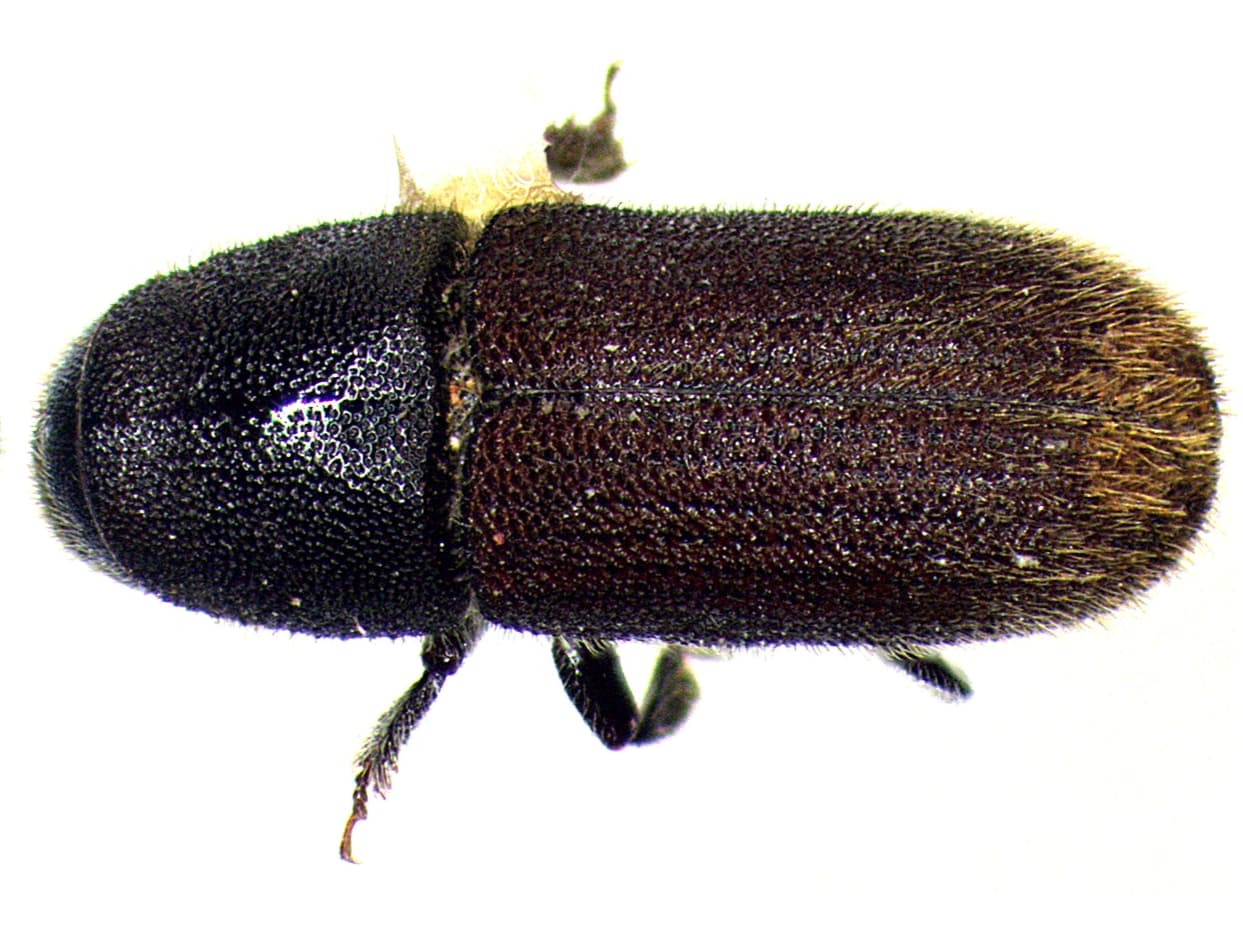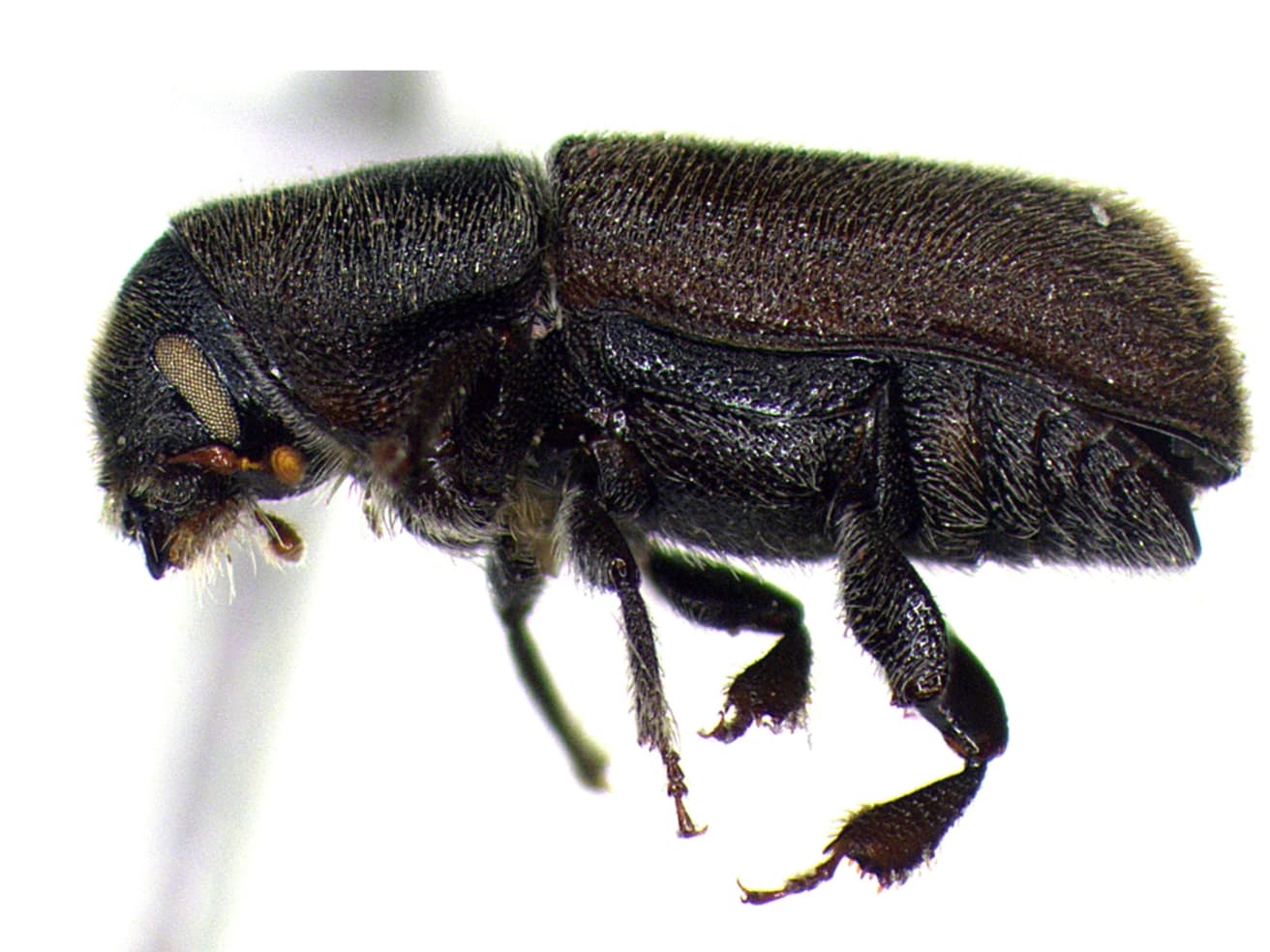
Hylurgus ligniperda is a secondary pest of coniferous species that attacks weakened trees, fresh stumps, leftover logs and debris. Due to their high moisture requirement, beetles often infest parts of trees or logs in contact with soil and can be found infesting the root crown or even roots themselves (Tribe 1991). External signs of beetle infestation can be limited but in rare cases reddish boring dust extruding from the tree during tunnelling can be present. Mortality of mature trees does not often occur due to infestations of H. ligniperda.
A Mpumalanga pine and eucalyptus plantation on rolling hills, a forester from behind measuring a trunk with a diameter tape (illustration)
01/02
Click to pause
Tree Protection Co-operative Programme
Red-haired pine bark beetle / Hylurgus ligniperda
Hylurgus ligniperda (Fabricius, 1787) (Curculionidae: Scolytinae)
Common NameRed-haired pine bark beetle / Hylurgus ligniperda
Scientific NameHylurgus ligniperda (Fabricius, 1787) (Curculionidae: Scolytinae)
SynonymsBostrichus ligniperda Fabricius, 1787 Bostrichus elongatus Herbst, 1793 Hylesinus flavipes Panzer, 1795 Hylurgus longulus Kolenati, 1846
OriginEurope (Tribe 1992).
Distribution in South AfricaKwaZulu-Natal, Mpumalanga, Western Cape.
Symptoms
Biology
Hylurgus ligniperda is a monogamous beetle that can have up to five generations per year, depending on the region and fluctuations in temperature. The beetles prefer cooler climates and are more active during autumn, followed by spring (Tribe 1991). Adults are strong fliers and will disperse into areas spanning multiple kilometres in response to volatile stimuli.
Brood establishment is initiated by a female beetle that bores a small tunnel into the host that ends in a nuptial chamber. Here she will mate with a single male, before continuing gallery construction. Her gallery consists of a single long tunnel branching off into egg galleries where she oviposits batches of eggs. Larvae emerge within the egg gallery and establish individual feeding tunnels along its walls where they will eventually pupate (CABI 2022).
Newly emerged adults will then disperse and often attack young seedlings (1-2 years), feeding on the roots and root collar. This maturation feeding of young beetles often results in the most damage and can result in seedling death. During overwintering, adult beetles will aggregate in tunnels located below the thicker bark of the root collar.
Management
Cultural control: There are several good silvicultural practices that can be followed to help control H. ligniperda infestations. Such practices include planting of pine in suitable areas to avoid unnecessary stress on the trees and removal of fallen trees, logs, stumps and roots, which can serve as breeding sites. Additionally, due to H. ligniperda preferentially infesting the below ground parts of the tree, in areas of high infestation delay in planting for 1 year is recommended.
Biological control: Thanasimus formicarius, a predatory clerid beetle, has been imported to New Zealand to control light infestations of H. ligniperda (Zondag 1979). Themnochila virescens, a predatory beetle originally imported to Australia for the control of Ips grandicollis, has been found to attack H. ligniperda (Lawson & Morgan 1993). No biological control is currently being used against H. ligniperda in South Africa.
Chemical control: Bark beetles are notably difficult to control using chemical methods and there is currently no effective chemical available to control populations of H. ligniperda. Some chemical insecticides have been used effectively to protect susceptible P. radiata seedlings by spray application of the insecticide to the stems and roots (Tribe 1992).
Gallery