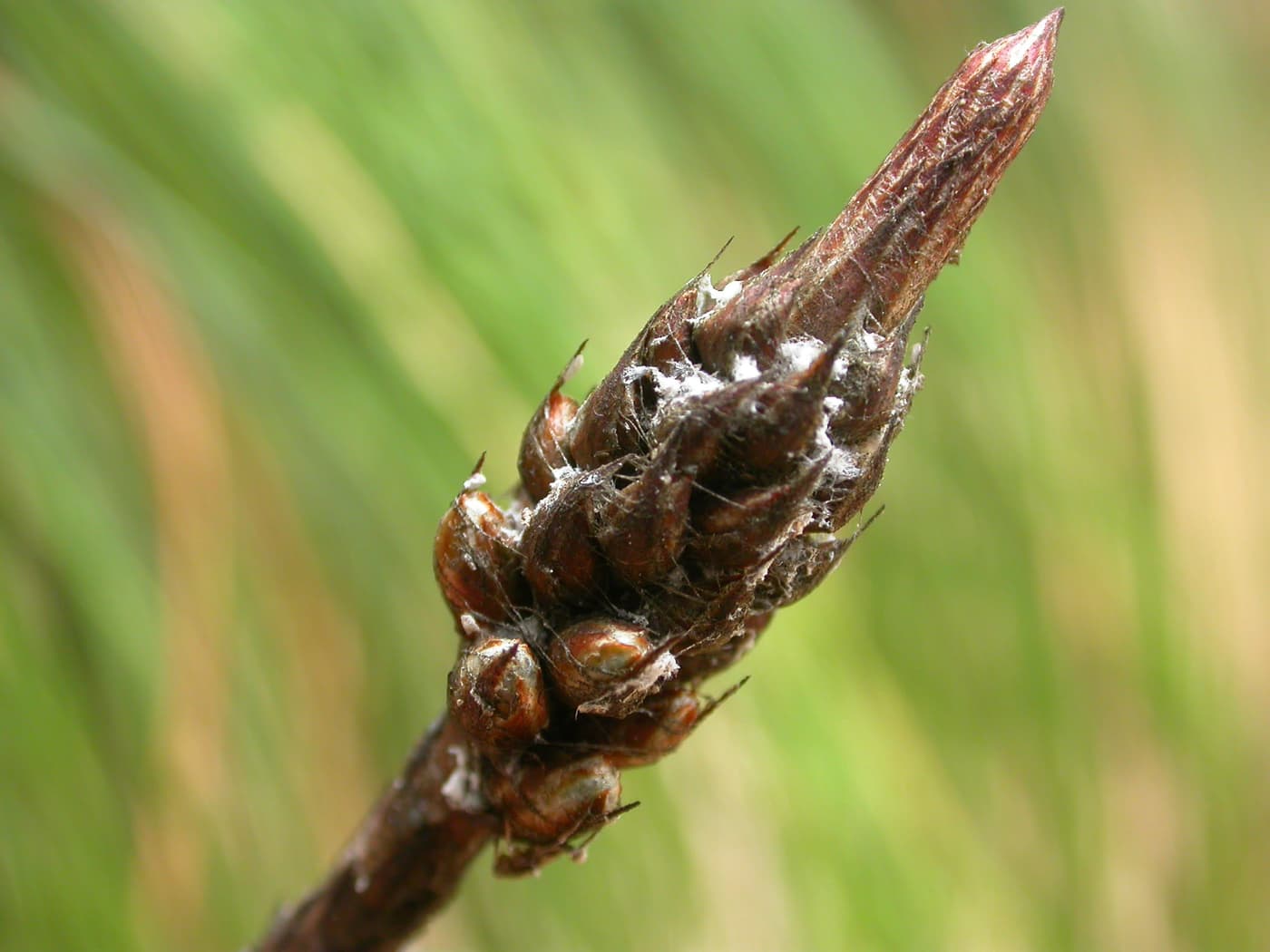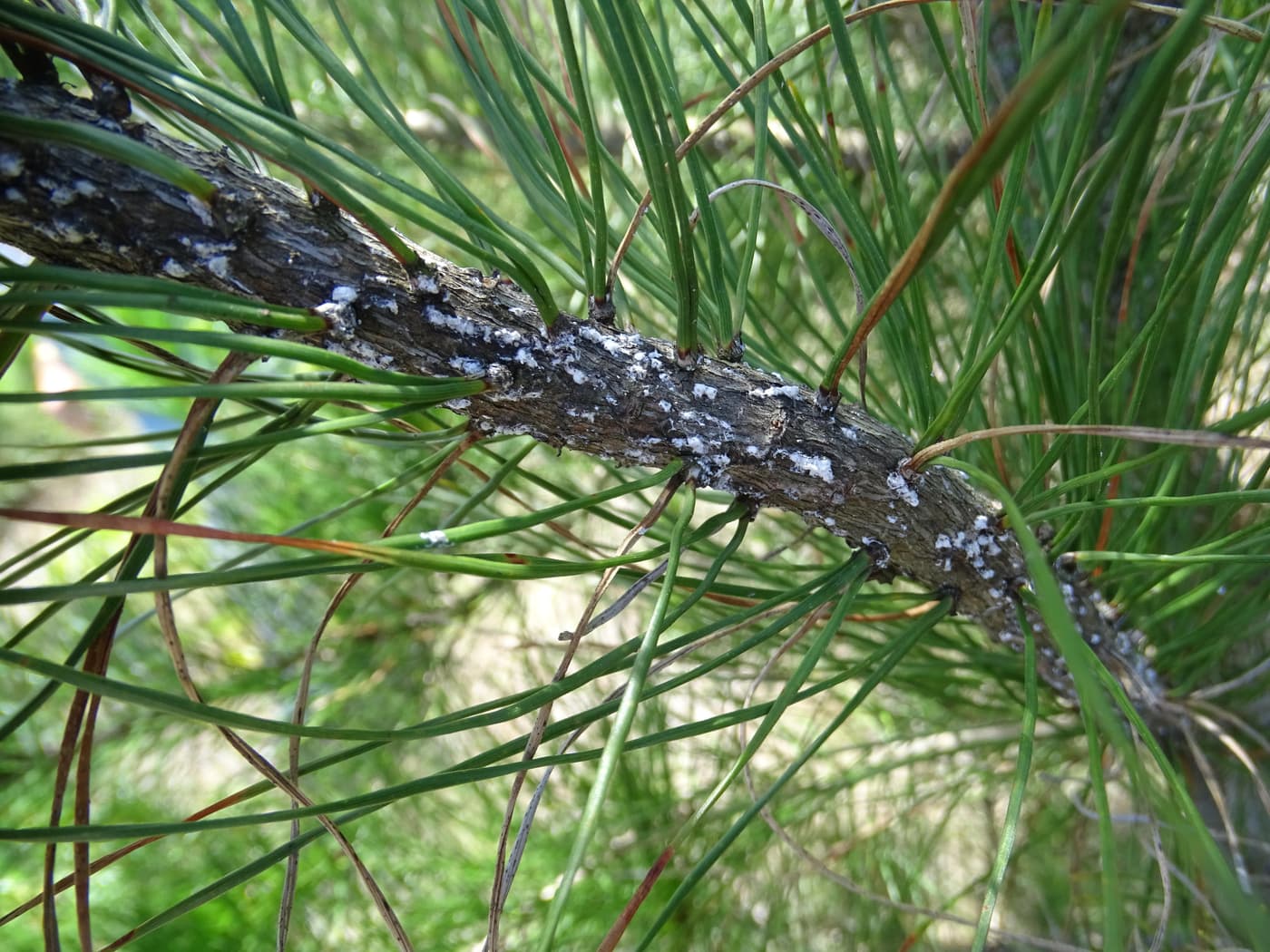
Symptoms include dying branches and trees as well as discoloration of the foliage, distortion, reduced growth of plant stands and resinosis (Mailu et al. 1978; McClure 1982). Other signs include a shortening of the infected needles' length (Day et al. 2003). According to Mailu et al. (1982), measurements of needle lengths alone might be sufficient to determine the extent of an infestation because of a highly significant negative relationship between those two variables and the number of aphids. In warm, dry weather, tree damage is most severe (Mailu et al. 1978).
A Mpumalanga pine and eucalyptus plantation on rolling hills, a forester from behind measuring a trunk with a diameter tape (illustration)
01/02
Click to pause
Tree Protection Co-operative Programme
Pine Wooly Aphid / Pineus pini
Pineus pini (Macquart)
Common NamePine Wooly Aphid / Pineus pini
Scientific NamePineus pini (Macquart)
SynonymsAnisophleba pini Koch Aphis pini Gmelin Kermaphis pini var. laevis Maskell Kermes pini Macquart Pineus boerneri Annand Pineus havrylenkoi Blanchard Pineus laevis (Maskell, 1885) Börner Pineus pini (Macquart, 1819) Börner Pineus simmondsi Yaseen & Ghani Pineus sylvestris Annand
OriginWestern and Central Europe (Blackman & Eastop, 1994).
Distribution in South AfricaMpumalanga, Kwazulu-Natal midlands and Limpopo.
Symptoms
Biology
All year, reproduction is asexual, with eggs produced parthenogenetically. Every year, there are at least three overlapping generations. There are significant differences between the hatching times of the first and last eggs laid because clutches of eggs are laid (one egg at a time) over a period of several weeks. Prior to the development of an adult, there are five immature instars. Hiemosistentes, which are heavily sclerotized adult females without wings, as well as second- and third-instar larvae, overwinter. The larvae transform into apterous progredientes, which are the summer form of the adult female and are lightly sclerotized, and alate (winged) females in the spring.
Management
Sanitary practices and cultural control:
Stress can make pine trees more susceptible to P. pini attack (Madoffe & Austara 1993) and therefore, choosing suitable planting sites is paramount to avoiding P. pini infestation (Day et al., 2003).
Biological Control:
Pineus pini can be effectively controlled by predatory Leucopis species such as L. tapiae, L. obscura, and L. nigraluna (Culliney et al. 1988).
Host-Plant Resistance:
Alternatively, P. pini can be controlled by replanting with a less susceptible pine species, but this is a time-consuming and potentially costly procedure that may result in unintended costs such as lower yields and/or quality.
Gallery