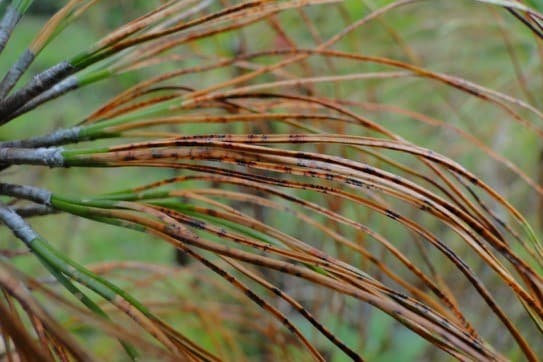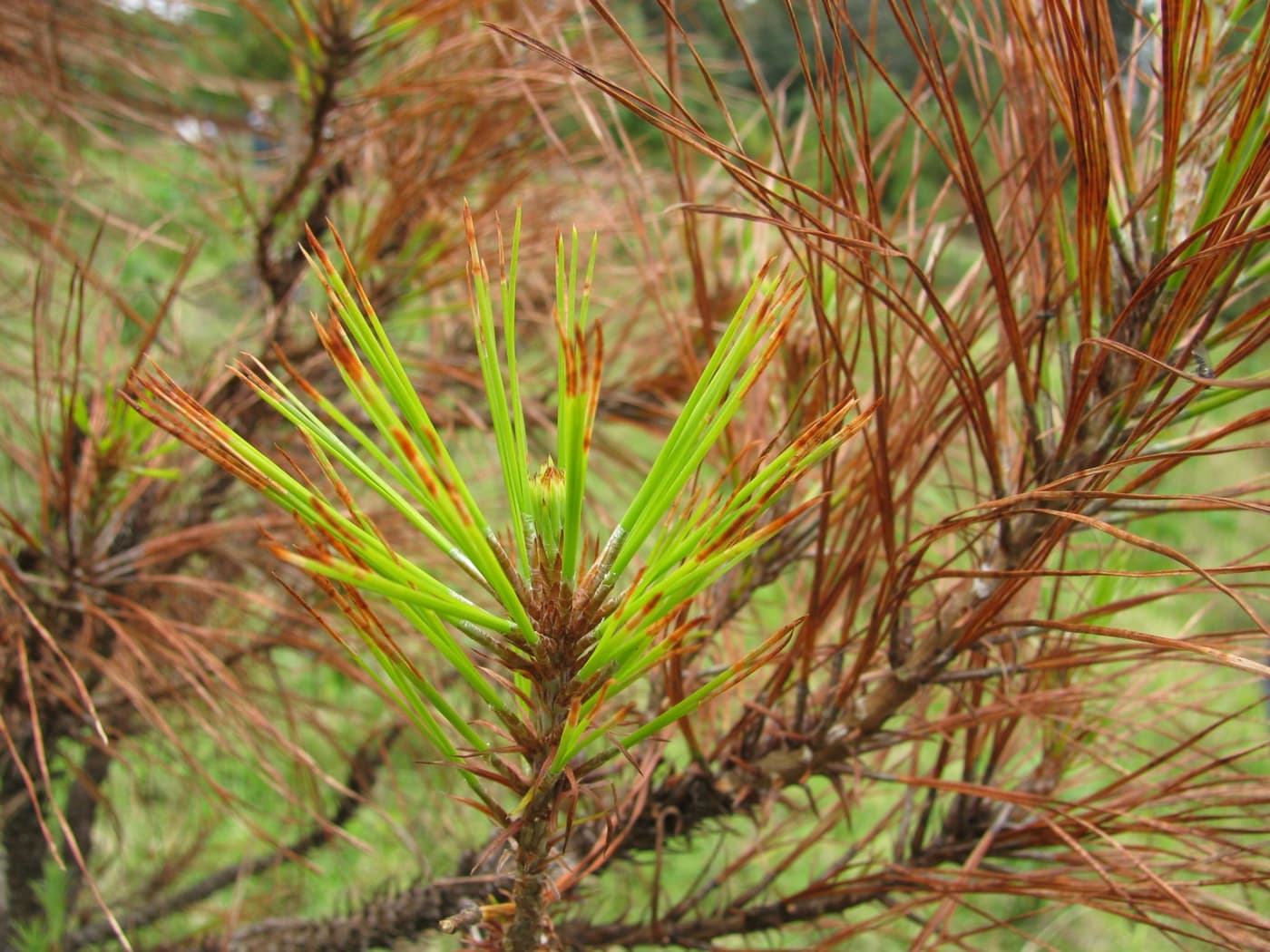
The first symptoms develop on the current years’ needle tips as chlorotic yellow bands to tan spots (Gibson 1979). On older needles, the bands become more visible and change a red-brown colour caused by the accumulation of a mycotoxin called dothistromin. As the fungus proliferates inside the needle, the needle is killed and fruiting bodies resembling black stromata emerges from the necrotic tissue. Heavy infestations cause defoliation of older needles, “lion tail” appearance in branches and stunted growth in young established plantations and mature trees. In severe cases, it can cause tree death (Bulman et al. 2013).
A Mpumalanga pine and eucalyptus plantation on rolling hills, a forester from behind measuring a trunk with a diameter tape (illustration)
01/02
Click to pause
Tree Protection Co-operative Programme
Dothistroma needle blight
Dothistroma septosporum
Common NameDothistroma needle blight
Scientific NameDothistroma septosporum
SynonymsHypostomum flichianum Vuill., Cytosporina septospora Dorogin, Septoriella septospora (Dorogin) Sacc. apud Trotter, Dothistroma pini Hulbary, Dothistroma septospora (Dorogin) M. Morelet, among others. The sexual stage was known as Mycosphaerella pini. The complete taxonomic revision and history for the genus Dothistroma can be found in Barnes et al. (2016).
OriginParts of Eurasia but there are also centers of diversity in Central America
Distribution in South AfricaLimpopo, Eastern Cape
Symptoms
Biology
Dothistroma septosporum is a hemibiotrophic fungus that can reproduce sexually and asexually. In the asexual life stage, the fungus reproduces by forming small black fruiting bodies within the red bands. Spores are released under optimal climatic conditions of high humidity and temperatures between 12-18ºC and are disseminated by wind, rain and mist clouds (Gibson et al. 1964; Gadgil 1967). The spore germinates on the needle surface, penetrates through the stomatal pores and colonizes the epistomatal chambers. During the colonization phase, the non-selective toxin, dothistromin, is produced and necrotic lesions form as result. Lesions are observed between 6 to 12 weeks after sporulation. Once the pathogen has established on the needle, new stromata develop and spores are released to continue the cycle (Kabir et al. 2015). The life cycle of the pathogen varies depending on the country where D. septosporum is found. For example, in tropical countries the life cycle is continuous which means that spores are able to infect at any time (Rodas et al. 2016); whereas in many countries of the Southern Hemisphere, the fungus overwinters in needles until favourable conditions are available.
Dothistroma septosporum is also a heterothallic fungus, meaning individuals either carry the MAT1-1 or MAT1-2 gene and individuals of opposite mating types are required for sexual reproduction to occur (Groenewald et al. 2007). The sexual state of D. septosporum has rarely been observed in the Northern Hemisphere and no evidence of its presence in the Southern Hemisphere has been documented.
Management
Planting of resistant varieties such as Pinus patula
Gallery