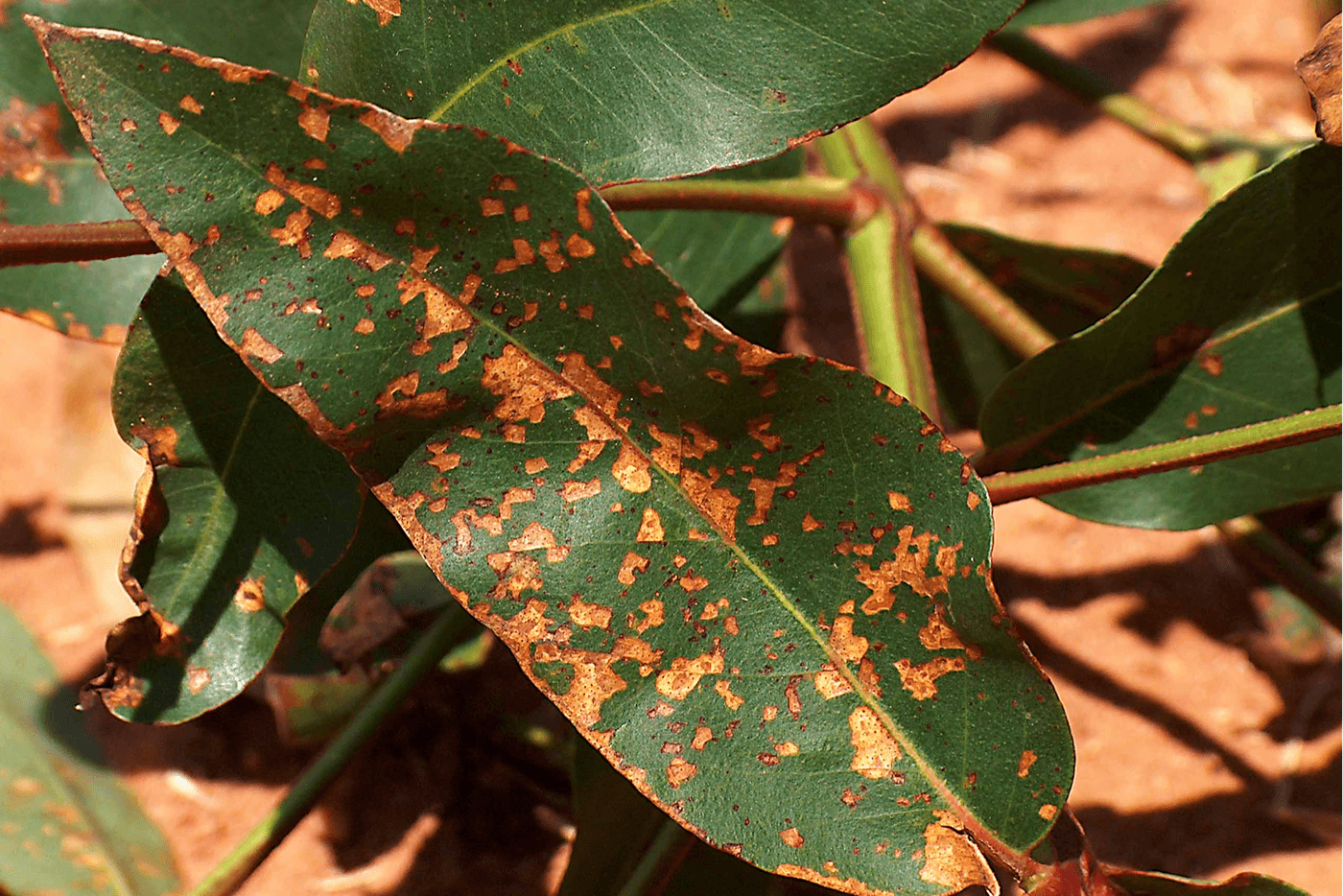
Bacterial blight and dieback is a disease of young Eucalyptus trees, either in the nursery or in newly established plantations. Symptoms include water soaked, angular lesions and interveinal necrosis of the leaves which is often concentrated along the main vein or at the edges. Lesions often extend into the petiole and twigs leading to dieback of the young shoots. In the case of Xae in Brazil, severe defoliation was recorded when the conditions were favourable for disease development (Ferraz et al. 2018). Symptoms caused by the various bacterial species appear similar and it is thus impossible to identify the causal agent based solely on symptom expression. Pantoea ananatis and Xvv have been isolated together from the same infected plant (Coutinho et al. 2015).

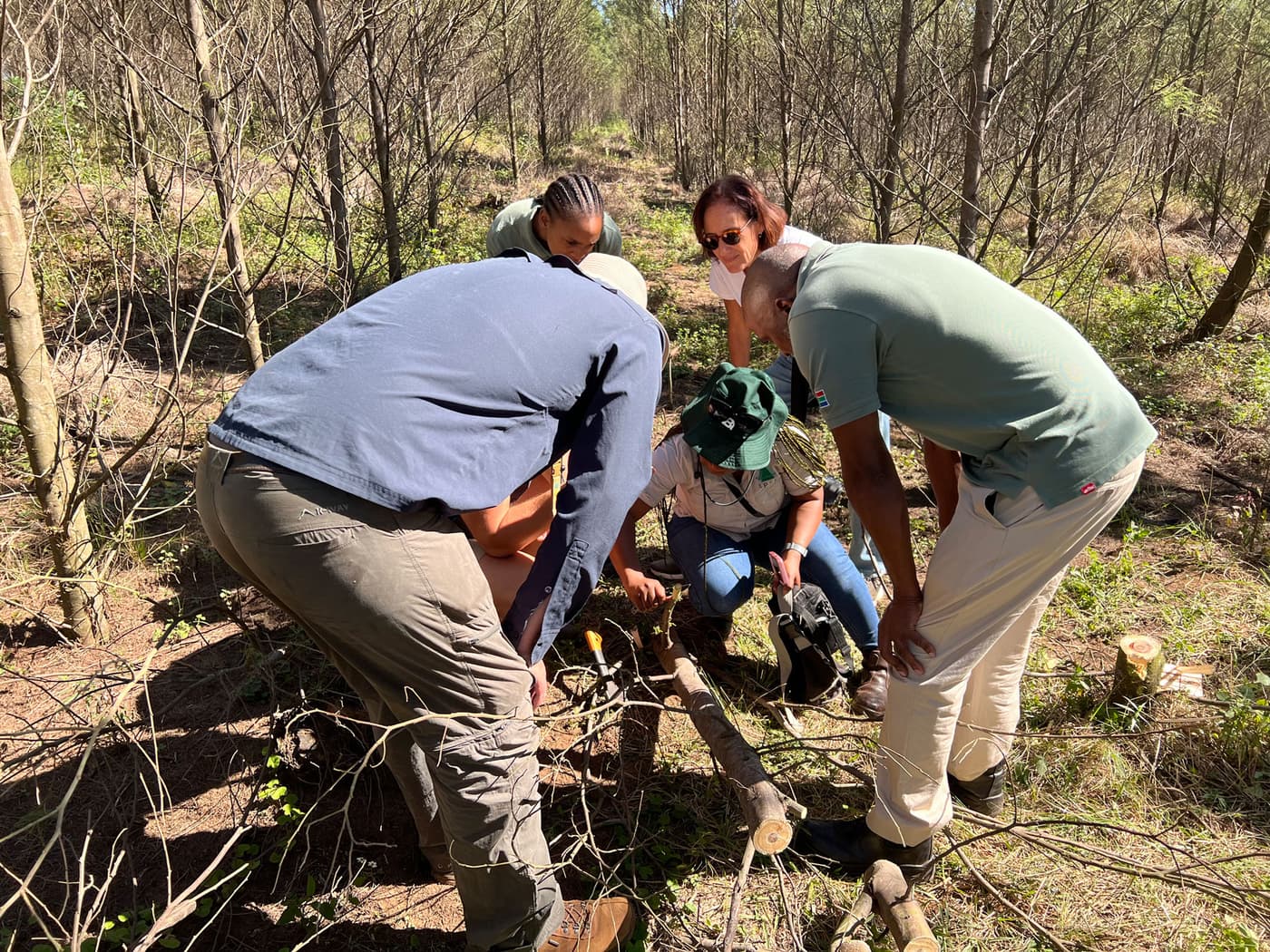
A Mpumalanga pine and eucalyptus plantation on rolling hills, a forester from behind measuring a trunk with a diameter tape (illustration)
01/02
Click to pause
Tree Protection Co-operative Programme
Pantoea blight and dieback
Pantoea ananatis , Xanthomonas axonopodis , Xanthomonas vasicola pv. vasculorum , Xanthomonas dyei pv. eucalypti
Common NamePantoea blight and dieback
Scientific NamePantoea ananatis , Xanthomonas axonopodis , Xanthomonas vasicola pv. vasculorum , Xanthomonas dyei pv. eucalypti
SynonymsPantoea ananatis = Erwinia ananas Serrano 1928, Erwinia uredovora (Pon et al. 1954) Dye 1963; Xanthomonas vasicola pv. vasculorum = X. vasculorum (Cobb 1894) Dowson 1939, X. campestris pv. vasculorum (Cobb 1894) Dye 1978, Xanthomonas campestris pv. eucalypti (Truman 1974) Dye 1978
Distribution in South AfricaKwaZulu-Natal, Limpopo, Mpumalanga
Symptoms
Biology
In the case of P. ananatis and Xvv, younger leaves are more susceptible than older leaves. This is contrary to the case with Xae where older leaves were shown to a have a higher percentage of leaf area with lesions than younger leaves (Neves et al. 2014). Free water on the leaf surface is required for penetration of the bacteria. They enter through natural openings such as hydathodes and stomata, and wounds. The optimal temperature for the development of the disease caused by Xae is between 26°C and 30°C (Neves et al. 2014) and between 20°C and 25°C with high relative humidity in the case of P. ananatis (Coutinho et al. 2002).
Gallery